Many product teams perceive the focus on User Outcomes as arbitrary goal-setting and the opposite of serving users. And it‘s easy to understand why.
Many widely shared examples of User Outcomes out there read like this:
„Users buy more tickets“
„Customers use more integrations. “
„Returning shoppers add more items to their basket.“
A product leader recently approached me after a conference talk, sharing his team‘s concerns that Outcomes would just be repackaged business goals. Looking at the above examples, his team would be right. These read like how the company or business wants their customers to behave.
To make Outcomes (aka changes in human behavior) useful, you have to remember that they should describe changes in behavior that are useful to the audience you intend to serve, which requires a proven problem.
It‘s not enough if Outcomes describe „technically correct“ changes in behavior. Instead, there should be a clear connection between business-informed research intent and insights generated by qualitative and quantitative techniques.
Another way to look at Outcomes as flipped user problems:
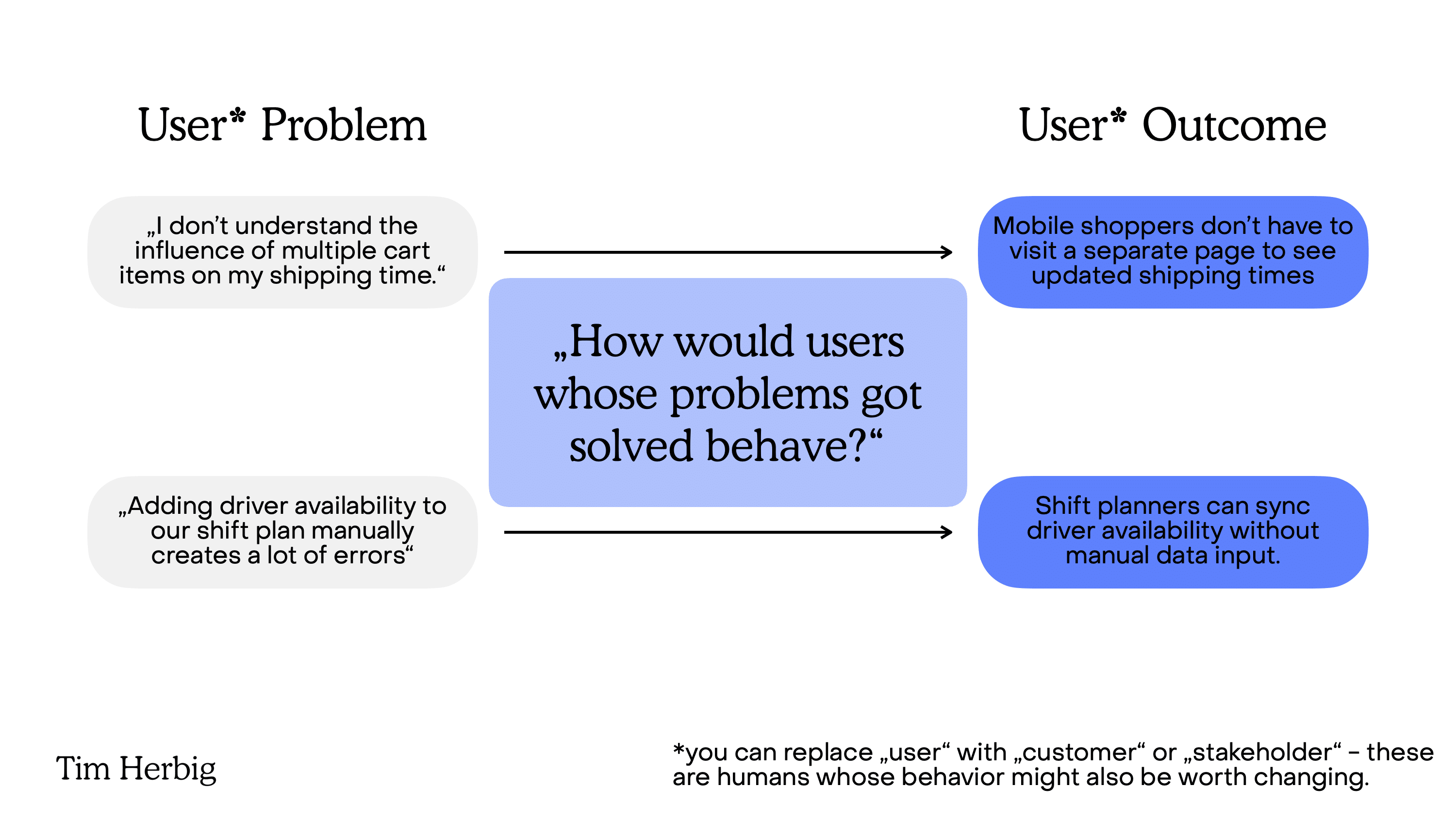
The simple question teams need to try and answer here is, „How would users whose problems got solved behave?“ This will then be the foundation for finding appropriate measures to set your OKRs.
How to put this Theory into Practice:
- Do your prioritized Outcomes read like something the company wants? If yes, dig for a problem worth solving based on first-hand evidence.
- Ask team members how you‘d know you solved this problem for users go from problem to Outcome.
- Don‘t focus on User Outcomes for the sake of it. Make sure you prioritize Outcomes that serve mid-term business goals through Impact Mapping.
If you enjoyed this, you can share the essay on LinkedIn here.
Thank you for Practicing Product,
Tim
PS: My friend Itamar released his long-awaited book “Evidence-Guided” last week. It’s a practical synthesis of the principles taught by Itamar to help companies move away from opinions and towards more evidence. I highly recommend checking it out
Amazon USA: http://amazon.com/dp/B0CJCDP1H7
Amazon UK: http://amazon.co.uk/dp/B0CJCDP1H7
Amazon Germany: http://amazon.de/dp/B0CJCDP1H7
Early Bird In-Person Workshop Rates End Soon
The Early Bird rates for my January 2024 workshops on Product Strategy, Product OKRs, and Product Discovery in Berlin expire on October 10. Secure your spot to make the most of your 2024 L&D budget.
Bundle options are available if you’re interested in more than one workshop. For team packages, reach out via email for a custom quote.
Content I found Practical This Week
On the Art and Science of OKRs
I was a guest on the Dreams With Deadlines podcast to talk about my personal experience of “getting into OKRs,” why I think most OKRs lack everyday usefulness, why product teams often (rightfully) resist the introduction of OKRS, and much more.
My critique of “the Spotify Model”: Part 1
Although I think cross-pollination is still valuable, there’s now probably more emphasis on Spotify’s version of the “paved path” pattern, called Golden Path. There is training, support, tooling, etc. for the Golden Path BUT you are able to make a different decision if it makes sense and are willing to take on the overhead yourself. Someone will probably check in if the decision doesn’t make sense. Cross-pollination > standardization? It’s more cross-pollination AND Golden Paths AND Tech Radar > imposed standardization.
Picking sharp problems, increasing virality, and unique product frameworks
Frankly, it’s rare that I genuinely enjoy a product management interview podcast in full. But this conversation by Lenny with Oji Udezue was a delightful exception. In particular, Oji’s take that it’s more important to understand the fundamentals of what constitutes a framework than learning new ones resonated with me.